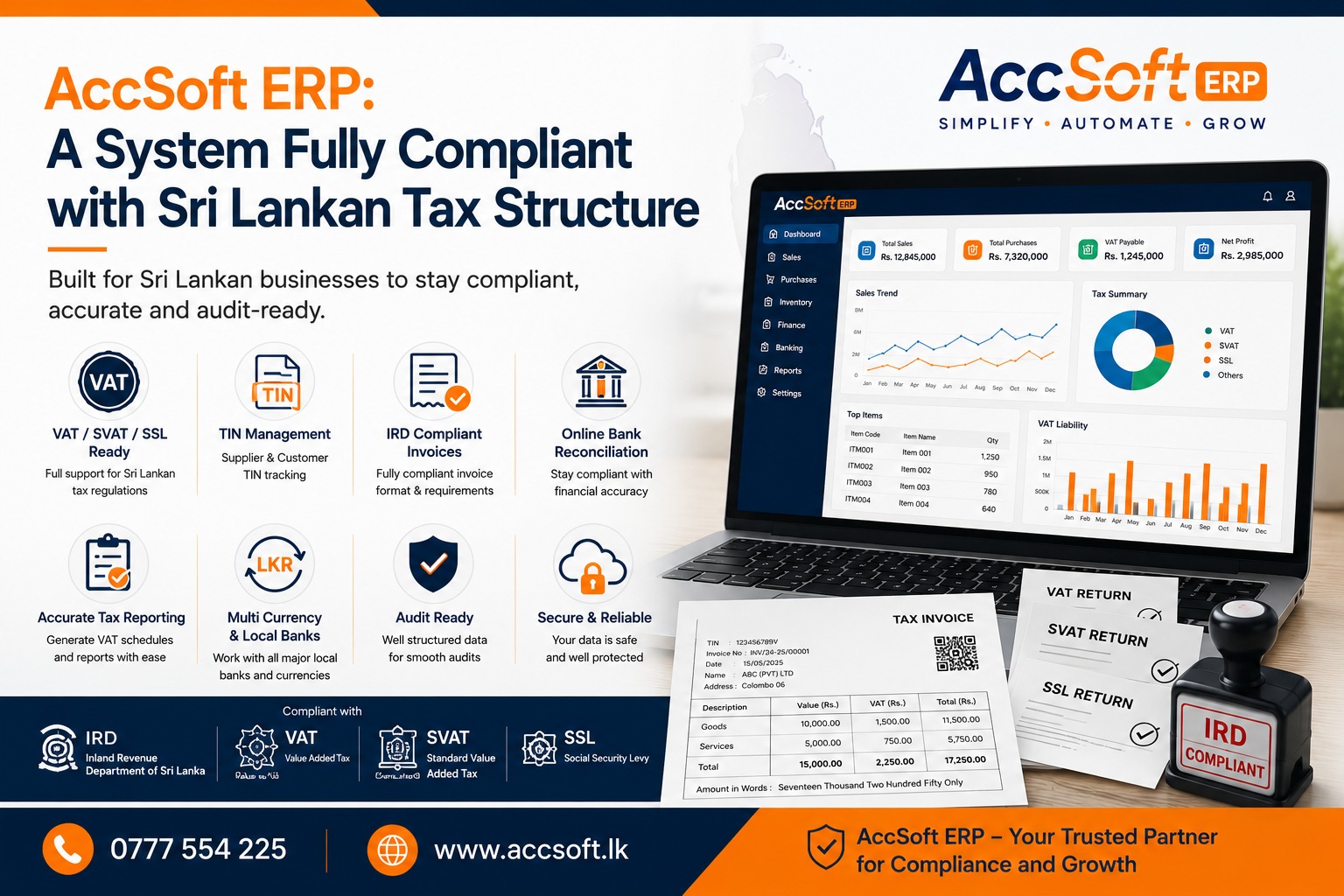
When businesses look for ERP software in Sri Lanka, they often focus on features first. Can it handle inventory? Can it print invoices? Can it generate reports? Can the accounts team use it easily? All of that matters.
But in Sri Lanka, there is another question that is just as important:
This is where many businesses only realise the problem after implementation. A system may look impressive on paper, but if it does not properly support Sri Lankan VAT, SSL, invoice formats, reporting needs, and local business practices, the accounts team will still end up doing manual work outside the system. That is not what an ERP should do.
Local Tax Compliance Is Not a Small Matter
Sri Lankan businesses operate in a tax environment that requires accuracy and proper records. Invoices must be correct. VAT calculations must be clear. Customer and supplier information must be maintained properly. Reports must be available when needed. Audit trails must be reliable.
When these things are handled manually, mistakes can easily happen. A small error in tax calculation, invoice format, or reporting can later become a bigger issue during an audit or tax review. This is why businesses need software that is not only powerful, but also locally relevant.
Why Foreign Systems Often Need Workarounds
Many international ERP and accounting systems are built for global markets. They may support general accounting and standard tax functions, but Sri Lankan businesses often need more specific controls. For example, a local business may need:
- VAT handling compliant with Sri Lankan requirements
- SSL (Social Security Levy) support
- IRD-compliant invoice formats
- Supplier and customer TIN details
- Local cheque and voucher formats
- Local bank-related requirements
- Reports expected by Sri Lankan accountants and auditors
If the software does not support these properly, the business starts using Excel sheets, manual calculations, custom reports, or separate systems. That defeats the purpose of having an ERP.
How AccSoft ERP Supports Sri Lankan Tax Requirements
AccSoft ERP has been developed with Sri Lankan businesses in mind. It supports local tax and accounting requirements, helping businesses reduce manual work and maintain better control over their financial records. The system is designed to support:
For a business, this means less time spent adjusting records manually and more confidence that the system is handling transactions correctly.
Better Invoicing and Fewer Manual Adjustments
Invoicing is one area where local compliance matters most. AccSoft ERP can generate invoices that support Sri Lankan tax requirements, including proper tax values, invoice details, and customer information. This helps the accounts team avoid last-minute corrections and manual invoice formatting.
When invoices are generated correctly from the beginning, customers, auditors, and management all benefit. There are fewer queries, fewer corrections, and a cleaner record for every transaction.
VAT-Inclusive Pricing for Practical Business Needs
Many businesses in Sri Lanka deal with both VAT-registered and non-VAT customers. In practice, pricing is not always straightforward. Some businesses quote prices inclusive of VAT, while others work with VAT-exclusive pricing.
AccSoft ERP supports these practical business situations, including inclusive pricing calculations for non-VAT customers. This is important because the system should match the way the business actually sells — not force the business to work around the software.
Clean Records Make Audits Easier
One thing most businesses learn over time is that audit readiness is not something you prepare at the last minute. It comes from maintaining proper records every day. AccSoft ERP helps businesses keep transaction records in a structured way, making it easier to review invoices, payments, tax values, customer balances, supplier balances, and reports when needed.
This gives management and accounts teams more confidence — knowing that records are maintained properly throughout the year, not just when an audit is announced.
Not Just Tax — Complete Business Control
Although Sri Lankan tax compliance is important, AccSoft ERP is not only about tax. It also helps businesses manage the wider operation. The full system includes:
- Accounting and financial management
- Sales and purchase management
- Advanced inventory management
- Serial number and warranty tracking
- Expiry date tracking
- Manufacturing and engineering operations
- Workshop management
- Real-time management reporting and dashboards
- Mobile sales force
This is what makes ERP different from basic accounting software. It connects accounting with daily business operations — and AccSoft does this while keeping Sri Lankan compliance built in at every step.