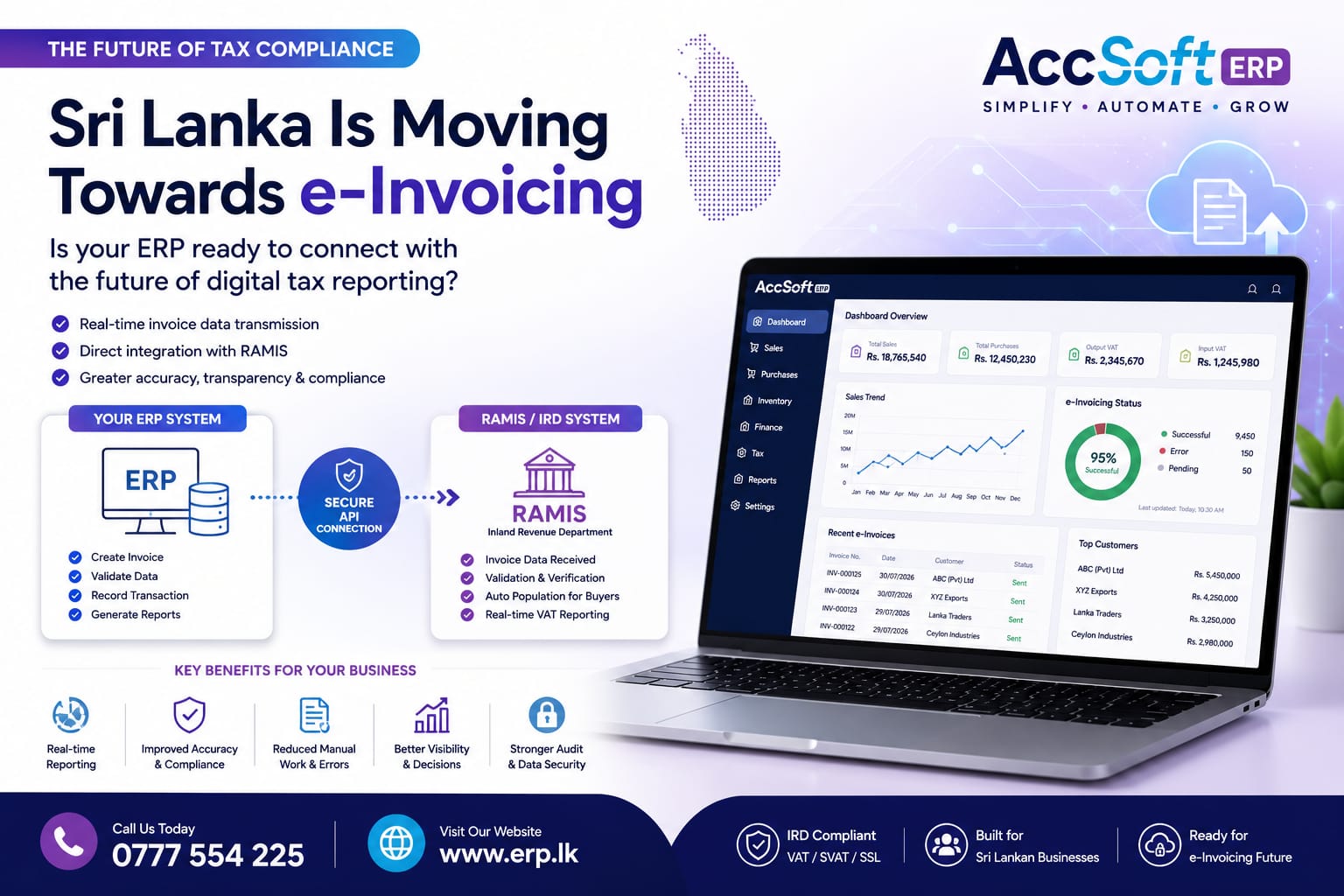
For years, many Sri Lankan businesses have followed a familiar process. Invoices are prepared in accounting software, printed or emailed to customers, and later included in VAT schedules. Before submitting the return, the accounts team checks the information, corrects mistakes, and uploads the relevant records to RAMIS.
That process is now beginning to change.
The Inland Revenue Department has started implementing a National e-Invoicing System under the 2026 Budget. A pilot programme is already in progress, with selected VAT-registered businesses upgrading their ERP systems to transmit invoice information directly to RAMIS through a Web API. The IRD expects the broader Web API integration to be completed by the end of 2026.
This is not merely another invoice layout change. It represents a major shift in how invoice information may eventually move between businesses and the tax authority.
What Is e-Invoicing?
Many people think an electronic invoice simply means preparing an invoice on a computer and sending it as a PDF. That is a digital invoice, but it is not an e-invoice in the sense intended by the new IRD system.
Under the IRD initiative, invoice information is transmitted digitally from a taxpayer's ERP system directly to RAMIS through a secure Web Application Programming Interface (Web API). The objective is to transmit VAT invoice and schedule-related information automatically and in real time — without repeatedly preparing and uploading the same data manually.
Why Is Sri Lanka Introducing e-Invoicing?
The 2026 Budget identified e-invoicing as part of a wider programme to strengthen tax administration through digitalisation. According to the IRD, the new system is intended to:
- Improve the accuracy and consistency of VAT reporting
- Increase transparency between buyers and sellers
- Reduce manual intervention and data-entry errors
- Automate parts of the tax administration process
- Connect taxpayers' ERP systems more directly with RAMIS
From a business point of view, this means that invoice accuracy will become more important at the time the transaction is entered — not only when the VAT return is being prepared.
Has e-Invoicing Already Started in Sri Lanka?
Yes, but it is being introduced in stages. The pilot has included selected businesses in garment exports, tea exports, and tea manufacturing. Tea broker systems have been upgraded to connect with RAMIS, with invoice, credit-note, and debit-note records relating to the Colombo Tea Auction being transmitted from May 1, 2026.
This does not mean every VAT-registered business is already required to transmit invoices through the API. However, the official direction is clear: ERP-to-RAMIS integration is expected to expand.
Which VAT Records Are Covered?
The current Web API process covers information relating to:
- Schedule 01 — Output tax, including exempt supplies
- Schedule 04 — Credit notes and debit notes
- Schedule 07 — Zero-rated supplies
When these records are successfully transmitted through the Web API, the supplier does not need to upload the same information again using Excel or the RAMIS Schedule Record Submission interface.
What Happens on the Purchaser's Side?
When a supplier submits Schedule 01 or Schedule 04 information through the Web API, the relevant details can be automatically populated in the purchaser's Schedule 02 and Schedule 04 records. The purchaser must review and approve the information before claiming the relevant input tax. Approved records are updated as "Matched" in RAMIS — up to 5,000 records at once.
This creates a closer link between the information reported by the seller and the information claimed by the buyer. A difference in the purchaser's TIN, invoice number, invoice value, or VAT amount may therefore become easier to identify.
The New Tax Invoice Format and e-Invoicing Are Not the Same
There has been some confusion between the revised VAT Tax Invoice format and the National e-Invoicing System. They are connected, but they are not the same thing.
- The revised Tax Invoice format (effective July 1, 2026) determines what information must appear on an invoice — supplier and purchaser TINs, invoice numbering, dates, descriptions, VAT amounts, and totals.
- The e-Invoicing System determines how that information may be transmitted electronically from an ERP system to RAMIS via Web API.
A business may already be printing the new compliant Tax Invoice without yet being connected to the RAMIS Web API. Both matter, but they are separate steps.
Why Your ERP Master Data Matters
e-Invoicing begins long before the invoice is transmitted. It begins with accurate master data. Customer names, registered addresses, and TIN numbers must be properly maintained. Items and services should have clear descriptions. VAT codes must be correctly assigned. Branch and invoice classifications must be consistent.
The IRD also requires meaningful descriptions rather than vague wording such as "items," "products," or "miscellaneous." When incorrect information is stored in the system, the same incorrect information can flow into every invoice and, eventually, into RAMIS.
Why Accounting Software Alone May Not Be Enough
A basic accounting package may record the financial part of a sale correctly. However, e-invoicing readiness may require much more:
- Controlled customer and supplier master records
- Proper TIN validation
- Standardised invoice numbering
- Branch and location identification
- User-level approval controls
- Credit and debit note workflows
- Integration capabilities with external systems
- Detailed audit trails
- Reliable inventory and transaction records
This is why ERP systems are becoming more important. An ERP does not merely print an invoice — it connects the invoice to the customer order, inventory movement, delivery, accounting entry, VAT record, and management report.
What Should Businesses Do Now?
Businesses should not wait until API integration becomes compulsory for their sector before examining their systems. A practical readiness review should cover the following areas:
✅ e-Invoicing Readiness Checklist
- Check your invoice format — Confirm invoices issued from July 1, 2026 comply with the revised Tax Invoice specifications
- Clean customer and supplier records — Review TINs, registered names, and addresses; remove duplicates
- Review your VAT settings — Check taxable, zero-rated, exempt, and excluded transactions are classified correctly
- Establish proper credit and debit note procedures — Staff should not informally alter completed invoices
- Review invoice numbering — Numbers should be unique, traceable, and comply with the 40-character limit and numeric continuity requirement
- Confirm API readiness with your software provider — Discuss future Web API capability with your ERP or accounting software vendor