- Across a 74-project Sri Lankan study, what separated successful ERP implementations from failed ones was not the product but how the project was managed.
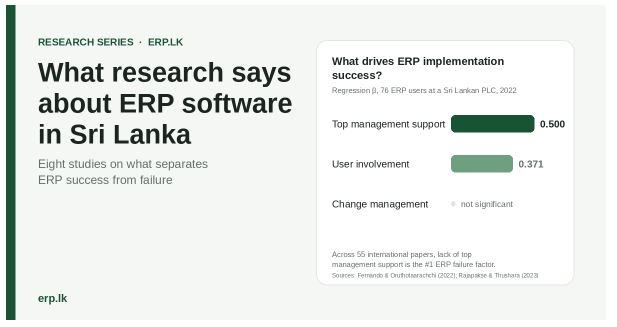
- Top management support was the strongest predictor in a 2022 study at a large listed Sri Lankan company (regression coefficient of 0.50, p < 0.01).
- Inadequate training was the second most common failure factor across 55 international ERP papers reviewed by Sri Lankan researchers.
- ERP usage explained 69% of the variation in operational performance among listed Sri Lankan manufacturers in a 2019 study.
- The 2022 economic crisis weakened ERP adoption but competitive pressure remained the strongest driver. Government incentives had no measurable effect.
- The product chosen did not affect success in any of the Sri Lankan studies reviewed.
An ERP system is a large decision for most Sri Lankan businesses, and one with a reputation for going wrong. This post looks at what peer-reviewed research has found when academics studied real ERP projects in Sri Lanka.
The short version: the research is consistent, and the main factor is not the software. Across a 74-project study, a single company case and a review of 55 papers, the same two factors appear at the top of every list: top management support and user training. Where both were present, ERP usage explained about two thirds of the variation in operational performance among listed Sri Lankan manufacturers.
What Separates ERP Projects That Succeed From Those That Fail?
There is a pair of papers by Vathsala Wickramasinghe and Vathsala Gunawardena of the University of Moratuwa, published in 2010 from the same survey of 74 ERP implementation projects across Sri Lanka.
The first, in the Journal of Enterprise Information Management, compared projects judged successful against those that were not, and asked which elements differed between the two groups. The list is long and almost none of it is technical:
- Training and education
- User involvement
- Managing user expectations
- Interdepartmental cooperation
- ERP team composition and teamwork
- Project management and a project champion
- Business process re-engineering and customisation
- Change management and culture
- Effective communication
- Software testing and troubleshooting
The performance of the project did not differ with the number of modules implemented, the product chosen, or the number of employees affected. What varied was how the project was run by the organisation.
The second paper, in Enterprise Information Systems, narrowed this to people factors and found three that were significant predictors of project success:
- Project team competence
- Rewards for the people doing the work
- Communication and change management
Rewards is something most companies miss. An ERP implementation can add months of extra work to the finance, stores and sales staff who have to run the old and new systems in parallel. The study found that recognising that effort was a predictor of whether the project succeeded.
The Factor That Keeps Appearing: Top Management Support
A 2022 study from NSBM Green University tested this inside a single large Sri Lankan company. Fernando and Oruthotaarachchi surveyed 76 ERP users at Brown and Company PLC and tested three success factors against how successful the implementation was judged to be.
| Factor | Correlation with ERP success | Regression coefficient | Significant? |
|---|---|---|---|
| Top management support | 0.722 | 0.500 | Yes (p < 0.01) |
| User involvement and satisfaction | 0.673 | 0.371 | Yes (p < 0.01) |
| Change management practices | 0.121 | 0.047 | No |
The strongest factor, by a clear margin, was top management support. Second was user involvement. Formal change management practices, surprisingly, had no significant effect in this company. The authors suggest this may mean the programme existed on paper more than in practice.
This pattern is not a Sri Lankan quirk. Rajapakse and Thushara reviewed 55 peer-reviewed ERP papers published between 2000 and 2022 and ranked 35 failure factors by how often they appeared. The top five were:
- Lack of top management support
- Inadequate education and training
- Mismatch between the system and the business strategy
- Lack of capable project managers
- Users unwilling to use the system
The review found that the first factor, lack of top management support, hurts most in Asian countries.
Does ERP Actually Improve Performance?
In the companies that use it properly, yes, and the Sri Lankan evidence is unusually clean because it covers an entire population rather than a sample. Jayarathna, Herath and Kumudumali of the University of Kelaniya surveyed every manufacturing company listed on the Colombo Stock Exchange, with 34 of 39 responding, and measured how heavily each company used eleven ERP modules compared against operational performance across cost, cycle time, quality and customer service.
ERP usage was a strong predictor of operational performance (standardised coefficient of 0.831, p < 0.001), and explained about 69% of the variation between companies. Financial accounting was the most heavily used module, with 88% of companies rating it as highly used. Payroll and quality management were used much less. E-commerce was barely used at all.
The usage spread is the interesting part. Only about a quarter of these large, listed companies described their ERP as highly used. Another quarter said rarely used. These companies had already paid and installed the system. The performance gap between the two groups is the cost of leaving modules switched off.
What the Economic Crisis Did to ERP Adoption
The most recent Sri Lankan ERP study is also the most relevant to anyone deciding now. Opatha and Withanaarachchi of the University of Kelaniya surveyed 159 managers with ERP experience during the 2022 to 2023 crisis and modelled what drives ERP adoption and how the crisis changed it.
Six factors drove adoption, all positively and significantly:
| Driver of ERP adoption | Path coefficient |
|---|---|
| Competitive pressure | 0.394 |
| ICT already in use by the firm | 0.387 |
| ICT infrastructure | 0.337 |
| Human capital (staff capability) | 0.292 |
| Trading partners' readiness | 0.276 |
| Demand for products and services | 0.240 |
The crisis weakened every one of those links, and significantly so for four of them: trading partners' readiness, demand, infrastructure and competitive pressure. When customers and suppliers were themselves struggling, demand was falling and import restrictions made hardware hard to get, companies that would otherwise have adopted an ERP held back.
Two details matter for a buyer today. First, competitive pressure was the strongest driver, ahead of anything technical: companies adopted ERP because rivals had. Second, government policy had no significant effect on any of the relationships. Businesses did not wait for incentives, and incentives did not change their minds.
Two Sector Cases: FMCG and Apparel
FMCG with foreign consultants
Herath and Wijenayake of the University of Kelaniya studied four Sri Lankan FMCG companies that had gone live on SAP in 2016. All four had used foreign implementation consultants, and the authors found this burdened users and slowed support once the consultants left. The challenges the companies named were familiar:
- High investment in hardware, software and training
- Resistance to standardised processes
- Inadequate user training, which the paper calls "a must"
- Difficulty migrating legacy data
- Limited local consultancy
The paper also cites the widely quoted figures that about 90% of ERP implementations run late or over budget and only about a third fully achieve their goals, and notes that ERP adoption in Sri Lanka was estimated at under 7% of the global rate at the time of the study.
Apparel after go-live
Perera and Munasinghe studied post-implementation ERP in the apparel sector. Garment manufacturers appeared to have had more success with ERP than other Sri Lankan manufacturers, which fits with the sector's export discipline and buyer compliance requirements. But the problems that remained after go-live were not technical: ineffective change management, weak top management support and gaps in business process re-engineering.
The two cases make a practical point about vendor choice. The FMCG companies' difficulty was not the system. It was that the people who understood the system were on a plane home. Local support capacity is a success factor in its own right, and the research on training and ongoing user involvement explains why.
What This Means If You Are Choosing an ERP in Sri Lanka
Six things the research supports, none of which depend on which product you pick:
- The managing director has to own it, visibly. Top management support was the strongest factor in the Brown and Company study (coefficient of 0.5), and the number one failure factor across 55 international papers.
- Budget training as a line item, not an afterthought. Inadequate training was the second most common failure factor worldwide and the first thing the Moratuwa study found differed between successful and failed projects. Training is not a day at go-live. It is the months after.
- Reward the people doing the double work. The Moratuwa study found that rewards for the implementation team predicted success. Parallel running is extra work for finance, stores and sales staff.
- Choose for local support, not brand. Module count, product and company size made no difference to success in the 74-project study. What the FMCG companies suffered from was consultants who went home.
- Switch on the modules you paid for. Among listed manufacturers, ERP usage explained 69% of the variation in operational performance, and a quarter of them were barely using the system they owned.
- Do not wait for the next crisis to pass. The 2023 study shows competitive pressure is the strongest driver of adoption and government policy makes no difference.
Frequently Asked Questions
Why do ERP implementations fail in Sri Lanka?
What is the single most important ERP success factor?
Does ERP improve business performance in Sri Lanka?
How did the economic crisis affect ERP adoption?
Is a foreign ERP brand safer than a local one?
Ready to Discuss Your ERP Project?
AccSoft ERP has been implemented in Sri Lankan businesses for over 25 years. Our team handles implementation, training and ongoing support locally.