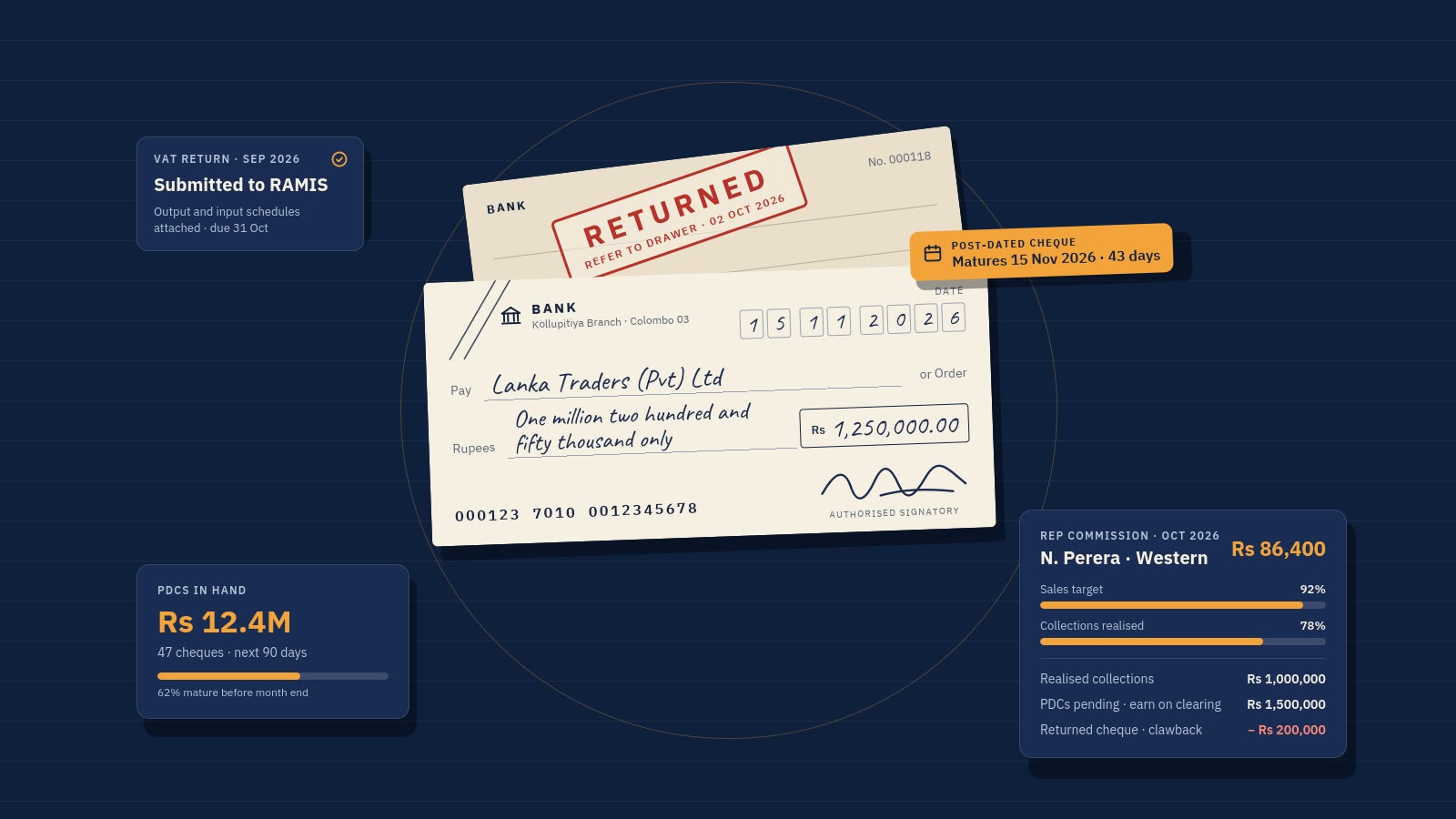
- Sri Lanka runs on post-dated cheques. Most international ERPs cannot handle the full PDC lifecycle natively.
- Returned cheques need automatic reversal in the ledger. AccSoft ERP handles this without manual journal entries.
- Sales rep commissions in Sri Lanka are often tied to collections, not invoices. When PDCs are involved, the calculation gets more complex.
- AccSoft ERP files VAT returns directly to RAMIS, the IRD online portal, with the required output and input tax schedules.
- Sri Lanka changes tax rates and rules in the budget every year. AccSoft ERP adapts without requiring a system upgrade.
- Accounts staff familiar with QuickBooks or Tally will recognise the screen layouts and workflows in AccSoft ERP.
Sri Lanka Runs on Cheques, Credit, and Sales Reps
Walk into any medium-sized business in Sri Lanka and you will find a filing cabinet full of post-dated cheques, a whiteboard tracking outstanding credit, and a team of sales reps who visit customers and collect payments on the road. This is not a sign of an outdated business. This is simply how commerce works in Sri Lanka.
International ERP systems are designed for international markets. They handle credit cards, bank transfers, SWIFT payments, and electronic invoices well. But they were not built with Sri Lankan business practices in mind. The result is that many Sri Lankan businesses end up running a global ERP for the core functions while still using spreadsheets, notebooks, and separate tools for the parts the ERP cannot handle.
AccSoft ERP was built in Sri Lanka for Sri Lankan businesses. The six areas below show exactly what that means in practice.
1. Post-Dated Cheques: The Full Lifecycle in One System
A post-dated cheque (PDC) is a cheque that a customer gives today but has a future date written on it. In Sri Lanka, this is one of the most common ways that customers manage credit. A customer might hand over five cheques dated for the next five months when they take delivery of goods.
For the selling business, this creates an accounting challenge. The cheque is in hand, but it cannot be deposited yet. The money is not in the bank. The customer still owes the amount. But the risk is lower than an open invoice because you have a legal instrument.
An ERP that does not understand PDCs will treat this like an unpaid invoice, which is incorrect. The PDC is a separate instrument that needs its own tracking.
AccSoft ERP handles the complete PDC lifecycle:
- Record the PDC when it is received, linked to the customer and the invoice
- View a list of PDCs by maturity date so the banking team knows what to deposit when
- Deposit the cheque on the correct date and update the bank balance
- Mark cheques that are presented to the bank as "in clearance"
- Clear the cheque once the bank confirms funds received
This is available inside the Sales and Debtors module, which connects directly to the cash book and general ledger.
2. Returned Cheques: Automatic Reversal, Not Manual Work
A returned cheque is a cheque that the bank rejects after presentment. This happens when the drawer does not have sufficient funds, the account is closed, or there is a signature mismatch. The bank returns the cheque to you with a "Refer to Drawer" or "Insufficient Funds" notation.
When a cheque is returned, several things need to happen in the accounts:
- The receipt that was posted when the cheque was collected must be reversed
- The customer balance must be restored to reflect the outstanding amount
- The bank balance must be updated to remove the cheque amount
- Any bank charges for the returned cheque must be recorded
- The cheque must be flagged so the collections team can follow up with the customer
In many businesses, this is done with manual journal entries. The accounts team receives a call from the bank, opens the ERP, finds the original receipt, manually reverses it, posts a new journal entry, and then informs the collections team. This takes time and leaves room for errors, especially if the team is busy or the returned cheque is not noticed quickly.
AccSoft ERP automates the reversal process. When a returned cheque is recorded in the system, the receipt entry is reversed, the customer balance is restored, and the cheque is flagged for collection follow-up. The accounts team handles the exception rather than doing the accounting manually.
This is managed inside the Cash Book and General Ledger module, which stays in sync with the customer ledger automatically.
3. Sales Rep Commissions: Calculated on Collections, Not Just Sales
In many Sri Lankan businesses, sales reps are paid a commission. But the commission is not always paid on the sale. It is paid when the customer pays. This is a very practical arrangement: the company does not want to pay out commission on a sale that the customer never actually settles.
This means the commission calculation needs to track two things: what the rep sold, and what was actually collected from those customers. The system must hold back the commission on any unpaid portion and release it when payment is received.
International ERPs typically calculate commission at the point of sale or at the point of invoicing. Very few handle collection-based commission structures natively. Businesses that need this usually end up maintaining a separate spreadsheet that they reconcile at the end of each month.
AccSoft ERP supports collection-based commission calculations. The rep's commission is tied to payments received, not invoices issued. The Mobile Sales Force module gives reps visibility into their own outstanding collections and commission status.
The PDC Complication
Here is where it gets more complex. If a customer pays with a post-dated cheque, when is the commission earned? Some businesses say the commission is earned when the PDC is received. Others say it is only earned when the cheque actually clears the bank. And if the cheque is returned, the commission that was paid out may need to be clawed back or offset against future earnings.
This is not a theoretical problem. Consider a rep who collected Rs. 500,000 in PDCs in September. The company pays commission at the end of the month based on PDCs collected. In October, one of those cheques for Rs. 120,000 is returned. The commission on that amount needs to be reversed or offset in the next payout.
AccSoft ERP can be configured to handle these scenarios, linking the commission logic to the actual cheque clearance status rather than just the collection event.
4. VAT Returns to RAMIS: Filed From Inside the ERP
The IRD (Inland Revenue Department) of Sri Lanka requires registered businesses to file VAT returns through RAMIS, the online Revenue Administration and Management Information System. The return must include output tax (VAT collected from customers) and input tax (VAT paid to suppliers), along with the required schedules.
Many businesses using international ERP software find that the system can generate a VAT report, but cannot submit directly to RAMIS. The accounts team must export the data, reformat it to match the RAMIS requirements, log in to the portal, and manually key in or upload the figures. This is extra work every month, and it introduces another opportunity for error.
AccSoft ERP generates the VAT return in the format required by RAMIS and supports submission through the portal. The output and input schedules are produced from the live transaction data in the system, so there is no need to reformat or reconcile with a separate spreadsheet.
This feature is part of the Cash Book and General Ledger module, which handles all financial reporting and tax compliance functions.
5. When the Budget Changes, the System Updates
Sri Lanka updates its tax rates and rules in the national budget each year. The VAT rate has changed multiple times in recent years. The Social Security Levy was introduced and its rate adjusted. Withholding tax rules have been revised. SVAT and SVAT exemption rules have shifted. Every time a rate changes, businesses using ERP systems need to update their software to reflect the new rate.
With an international ERP, this often requires a configuration change that either needs IT support, a system consultant, or a software update from the vendor. The vendor may not prioritise Sri Lanka-specific rate changes since the country represents a small portion of their global user base. Businesses end up waiting or doing workarounds.
AccSoft ERP is maintained by a team based in Sri Lanka that monitors every budget announcement. When the government announces a change, the AccSoft team prepares the system update and deploys it to clients before the new rate takes effect. Clients do not need to chase a global vendor or wait for a patch cycle.
The Dashboards module gives management a real-time view of tax liabilities and financial performance, which becomes particularly important in the period immediately after a budget change.
6. Your Team Already Knows These Screens
Many Sri Lankan businesses currently use QuickBooks, Tally, or a local accounting package. When they consider moving to an ERP, one of the biggest concerns is the learning curve for the accounts team.
International ERPs often use terminology and workflows that are unfamiliar to accountants trained in Sri Lanka. The chart of accounts structure may differ. The voucher entry process may be different. Reports may be in formats that local auditors and tax advisors are not accustomed to reviewing. This creates friction during implementation and slows adoption.
AccSoft ERP uses the accounting terminology, voucher formats, and report structures that Sri Lankan accounts teams are familiar with. The general ledger, cash book, and voucher entry screens follow conventions that accountants who have used local software will recognise. The transition from QuickBooks or Tally to AccSoft ERP is more of a step up than a step sideways.
AccSoft ERP vs International ERP: How They Compare on Local Needs
| Feature | AccSoft ERP | International ERP (typical) |
|---|---|---|
| Post-dated cheque management | Built in | Not available / workaround needed |
| Returned cheque auto-reversal | Built in | Manual journal entry required |
| Collection-based rep commission | Supported | Invoice-based only (in most cases) |
| RAMIS VAT return submission | Supported | Export and manual reformat required |
| SSL (Social Security Levy) support | Built in | Requires configuration |
| Budget rate change updates | Local team, fast update | Depends on global vendor schedule |
| Familiarity for QuickBooks / Tally users | High | Low to medium |
| Local support team in Sri Lanka | Yes | Usually not |
Does Local Mean Less Capable?
A common concern when businesses consider a local ERP over an international one is whether they are trading capability for familiarity. The assumption is that global vendors with larger teams and bigger budgets must have better software.
This assumption does not hold when you look at what Sri Lankan businesses actually need day to day. A manufacturing company in Colombo needs PDC management, RAMIS filing, collection-based commissions, local bank reconciliation formats, and a support team that answers the phone in their time zone. A global ERP that does not handle any of those things natively is not actually more capable for that business. It is less capable for the things that matter most.
AccSoft ERP covers the full scope of ERP functions: sales and debtors, financial management, inventory, manufacturing, engineering, workshop management, HR, payroll, and management dashboards. The difference is that it also does the things that matter specifically to Sri Lankan businesses, without requiring workarounds or additional tools.
Frequently Asked Questions
What is a post-dated cheque (PDC) and why does it matter in ERP?
How does AccSoft ERP handle returned cheques?
Can AccSoft ERP calculate sales rep commissions based on collections instead of sales?
Does AccSoft ERP support RAMIS VAT return submission?
Does AccSoft ERP update automatically when tax rates change each budget?
Will my accounts team find AccSoft ERP easy to use if they already know QuickBooks?
Is AccSoft ERP only for large companies?
How can I request a demo of AccSoft ERP?
Ready to See AccSoft ERP in Action?
Talk to our team about your business requirements. We will show you exactly how AccSoft ERP handles your PDCs, returned cheques, rep commissions, and VAT compliance in a live demo built around your industry.