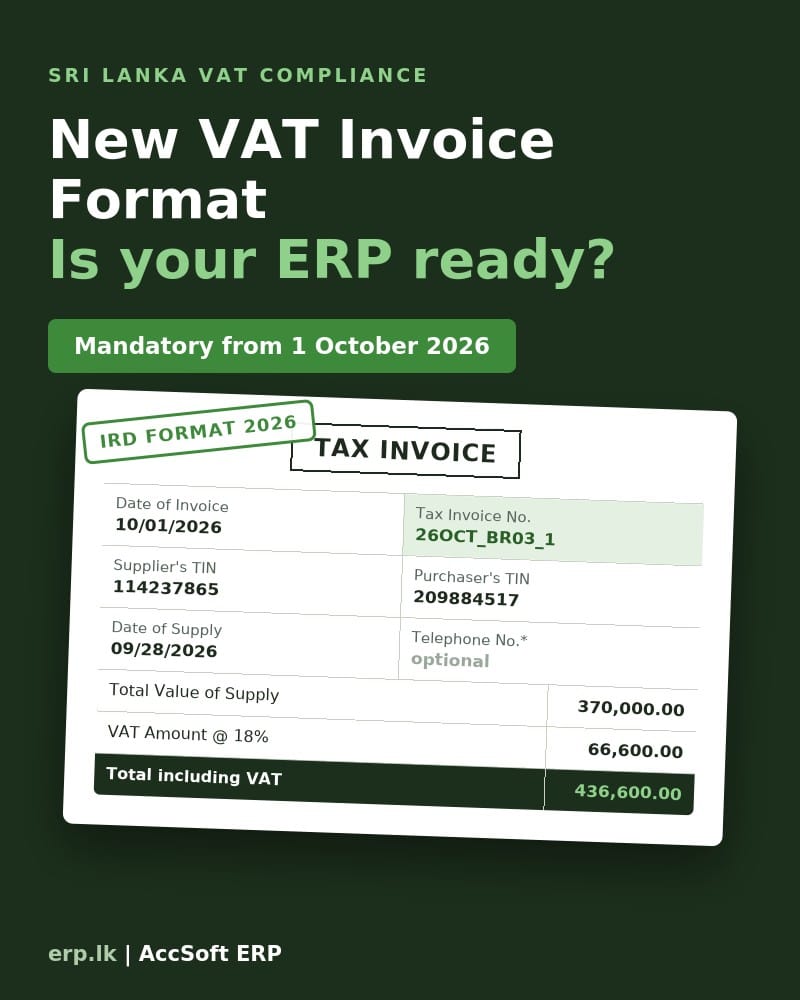
If your business is VAT registered, the tax invoices you issue are about to change. The Inland Revenue Department's revised Tax Invoice format, set out in Gazette No. 2481/22, becomes mandatory for all VAT registered persons from 1 October 2026.
The deadline was originally 1 July, then pushed back by Gazette No. 2500/106 issued in August — so businesses have been given one extra quarter. That quarter is nearly over.
At AccSoft we have been fielding the same questions from customers for months: what exactly has to change on my invoice, what happens if I get it wrong, and does my software handle it? This post answers all three — and clears up some incorrect information that has been circulating.
What Must Appear on a Tax Invoice from October 1
The revised format is best understood as a checklist. Every tax invoice for a taxable supply must clearly show:
- The words TAX INVOICE displayed prominently — not just "Invoice" or "Bill"
- Your TIN, registered business name and registered address, exactly as per your VAT registration
- The purchaser's TIN, name and address, where the purchaser is VAT registered
- A unique invoice serial number in the new prescribed structure (see below)
- Both the invoice date and the date of supply as two separate fields
- A specific description of the goods or services, and the quantity in measurable units
- The value excluding VAT, the VAT amount, and the total including VAT — in rupees with cents
- For approved foreign currency invoices: the LKR conversion values as well
What Is NOT Required — Despite What You May Have Read
Several summaries doing the rounds claim that telephone numbers, the total amount in words, and the mode of payment are compulsory. They are not. The gazette marks these fields with an asterisk, and clause 6.4 states plainly that asterisked items are optional. The same applies to place of supply and reference columns.
The Invoice Number: The Change Most Systems Will Trip On
The new serial number structure is YYMMM_QQQQ_XXXXX. Here is what each segment means:
| Segment | Example | Meaning |
|---|---|---|
| YY | 26 | Last two digits of the year the invoice is issued |
| MMM | OCT | First three letters of the month, in capitals |
| QQQQ | BR03 | Your own classification code — branch, department, project or invoice type. Letters, numbers or both, 1 to 15 characters |
| XXXXX | 1 | Running sequence number, digits only. No need to pad with zeros |
So the first invoice issued by Branch 03 in October 2026 would be numbered 26OCT_BR03_1. No spaces anywhere, maximum 40 characters, and the sequence should stay continuous rather than restarting whenever convenient.
This is precisely the kind of requirement that manual invoice books and basic templates struggle with — and that a properly configured system generates automatically without anyone thinking about it.
Two Details Worth Double-Checking
- Dates are in MM/DD/YYYY format. Unusual for Sri Lanka, but that is what the gazette prescribes for both the invoice date and the date of supply. An invoice dated 10/14/2026 means 14 October.
- Invoice date and date of supply are different things. The invoice date is when you issue the document. The date of supply is when ownership of the goods or services passes. Treating them as one field can push a transaction into the wrong VAT period — exactly the kind of mismatch that surfaces in an audit.
Why Compliance Suddenly Matters Much More
Two changes over the past year have raised the stakes considerably.
SVAT is gone. The suspended VAT scheme was abolished from 1 October 2025. Businesses that spent years settling B2B VAT through credit vouchers now charge VAT in money and issue standard tax invoices. For a large group of companies, the standard tax invoice is a new document in daily practice — arriving at the same moment its format rules have tightened.
Your customers will also start rejecting your invoices — because a defective invoice threatens their input VAT claim, not just your compliance.
And This Is Only Step One: e-Invoicing Is Next
The format change is the foundation for something bigger. Under the 2026 Budget, the IRD is rolling out a National e-Invoicing System in which VAT invoice data is transmitted in real time from your ERP system to the IRD's RAMIS platform through a Web API. Export sectors such as garments and tea are already integrated, and the IRD expects full integration by the end of 2026, extending to all VAT registered businesses in later phases.
One rule deserves special attention: a record submitted through the Web API cannot be amended or deleted afterwards. Corrections must be made by issuing a tax credit note or debit note. In other words, once real-time reporting arrives, your invoice needs to be right at the moment it is issued — not fixed at month end. That is a workflow question, and it is answered by your software, not your accountant.
A Quick Test: Is Your ERP Ready?
Ask these questions of whatever you use for invoicing today — whether that is an ERP, an accounting package, Excel or a printed book:
❓ ERP Readiness Checklist — October 2026
- Can it print TAX INVOICE prominently and show supplier and purchaser TINs, names and addresses?
- Can it generate serial numbers in the
YYMMM_QQQQ_XXXXXstructure automatically, per branch or department, without manual typing? - Does it capture the invoice date and the date of supply as separate fields, in the prescribed MM/DD/YYYY format?
- Does it show value excluding VAT, the VAT amount and the total including VAT on every invoice — calculated, not typed?
- Can it issue proper tax credit notes and debit notes, since those become the only correction path under e-invoicing?
- For exporters invoicing in foreign currency, can it show the LKR conversion values alongside?
- When the RAMIS Web API reaches your business, can your system connect to it — or will you be re-entering invoices by hand?
If the answer to any of these is no, you have a few weeks to fix it. If most of the answers are no, the honest fix is not a new invoice template. It is a system that produces compliant invoices by design.
How AccSoft ERP Handles It
AccSoft ERP was built in Sri Lanka around exactly these requirements — IRD-compliant tax invoice formats, VAT handled natively, structured invoice numbering, separate invoice and supply dates, and proper credit and debit note workflows. The management dashboard gives you a live view of your VAT position and outstanding receivables at any time.
If you are on QuickBooks, we configure the tax invoice layout for you as part of our support service. And if you are still invoicing from Excel or a printed book, October 1 is a good reason to have the conversation you have been postponing.
Frequently Asked Questions
Who has to follow the new VAT tax invoice format from October 1, 2026?
Do I have to show telephone numbers, the amount in words, or the mode of payment?
What does the new invoice number structure look like?
YYMMM_QQQQ_XXXXX. For example, 26OCT_BR03_1 is the first invoice issued in October 2026 under classification code BR03. No spaces, maximum 40 characters, and the sequence number is digits only with no need for leading zeros.